
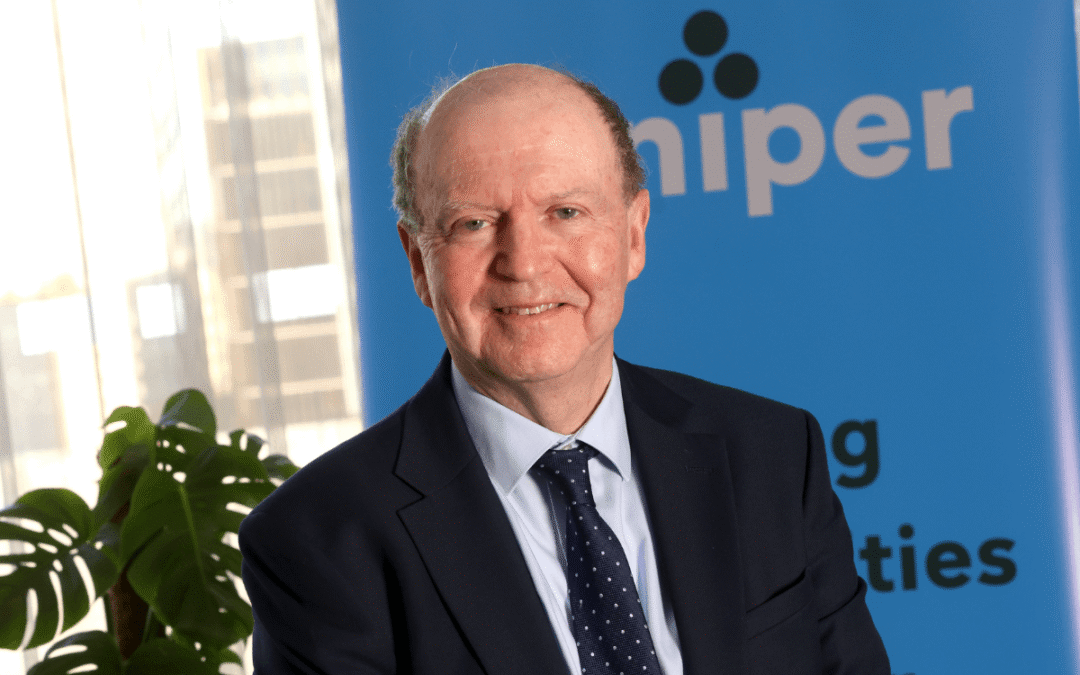
Six years on the board, two moments stuck with him: a cleaning machine he couldn’t operate, and a school meal he still talks about.
We’re starting a series this year that puts the people who lead Juniper front and centre. The board exists for a reason. Decisions made in the boardroom shape what happens in our kitchens, on our cleaning rounds and across our health and safety work every single day. We thought it was worth introducing the people behind those decisions, starting with our chair.
Steve Giles became chair of Juniper having joined the board as an independent non-executive director in 2019. He came at us from an unexpected angle. As a tutor at the Institute of Directors, Steve had spent two days running a course for a group from the London Borough of Newham. That group included Michael Hales and Philippa Terry. They were there to learn about commercial business. Steve, by the end of those two days, was thinking the same thing in reverse: how he could help theirs.
Six years later, he chairs our board. We sat down with him to talk about what the role actually is, what Juniper does best, and what he hopes the next five years look like.
What does the chair actually do?
The chair is a non-executive role, which means Steve isn’t at Juniper every day. “The person who leads the business is Michael,” he says. “My job is to lead the board.” That means chairing the monthly board meetings, setting agendas with Michael, and chairing the audit and risk subcommittee. But Steve sees the role as more than process. “I’m a sounding board, particularly for Michael, but also for Philippa and Michelle as executive directors, and for everyone else. I want them to feel they can talk to me about anything.” When he’s in at Old Town Hall in Stratford, he makes a point of going into the general area and saying hello. Visibility matters.
Holding on to our roots
Juniper grew out of Newham Catering and Cleaning Services. Asked what he’s most proud the business has held on to, Steve doesn’t hesitate: the schools. “Most obviously, that we’ve managed to retain so much of our schools business, particularly with primary schools. That’s a real foundation for our links into the community.” The fact that the business has come through the pandemic, inflation and rising commercial pressure with that base intact is, for Steve, a real achievement. He’s just as pleased about the cleaning work, much of which sits with both schools and the council itself. “It keeps us close. It demonstrates our expertise and our commitment.”
A combination that’s hard to find
It’s unusual to find catering and cleaning sat in the same business, alongside health and safety. Steve sees that as one of Juniper’s quiet strengths. “For a school, having one trusted partner looking after the food the children eat, the cleanliness of the building, and the health and safety of everyone in it, all three together, that’s powerful.” It’s a result of Juniper’s history, and one of the reasons partnerships with schools tend to last.
Partnership over transaction
That word, partnership, comes up a lot when Steve talks about the work. “From the board’s point of view, what we want is long term sustainable success, and that means having partners as our customers, not transactional relationships.” He’s quick to say that doesn’t mean an absence of problems. “Problems will arise. What partnership means is that through trust and respect, over time, we can solve them together.”
Waltham Forest as a turning point
This year’s Waltham Forest aggregation contract, 26 primary schools coming together to tender as one, was a genuine moment for the business. “It’s a contract win at scale, which we hadn’t really achieved in the previous six years,” Steve says. “It establishes Juniper as a credible player in the marketplace, able to compete against larger organisations and able to do that outside our natural base in Newham.” It’s also given the team an opportunity to embed Juniper’s practices in a new local authority, and to start building the same kind of community links there.
The London Living Wage question
Juniper has committed to paying the London Living Wage to all colleagues working in the Waltham Forest schools. Steve sees this through a governance lens. “London Living Wage is a validation for our employees. The workforce in our sectors often have a good overall package of remuneration but maybe not so much money in their pockets each month. It’s a way of properly remunerating them.” He’s honest about the trade-off. “It does give us commercial challenges, because we’re competing against firms that don’t pay it. We have to manage that. But in terms of treating our people fairly, it’s absolutely right.”
Values, when nobody’s looking
The hardest question of the conversation was about values, and how a board makes sure they show up in a kitchen on a Tuesday morning rather than just on a wall. Steve’s answer is honest. “It starts at the top. The tone is always set from the top.” He points to Michael’s passion, Philippa’s track record, and Michelle, our most recent executive addition, who Steve says was successful at interview because she connected with the values too. From there, the work is in the cascade. “We can’t do this overnight. Everybody has a part to play.”
What sets Juniper apart
Steve is direct on this. “We do what we say we’ll do. We operate with integrity and treat our stakeholders with respect. We aren’t driven by paying a dividend. We’re focused on the quality of what we deliver.” He also points to something many competitors don’t have: a properly functioning board, providing independent challenge and scrutiny to the executive. “It means there’s more assurance that operations are carefully thought through, risk is properly managed, and the business is run with integrity.”
The next five years
Steve’s hope for the next five years is straightforward. “I’d love to be able to say we’ve helped huge numbers of children grow, develop and reach their potential. Through the food and nourishment we give them, through making them safe in their environments.” He’d also like to see Juniper extending its cleaning expertise further into public buildings and commercial sites, and growing the health and safety side of the business as the bridge that ties everything together.
The cleaning machine, and the school dinner
Two moments from his early days have stuck with him. The first was being shown the cleaning equipment. “Somebody asked if I’d like to have a go on one of the machines. I was absolutely hopeless. It was a reminder that cleaning is a really skilled profession.” The second was a school visit with Michael, where he had a school meal that “was just sensational. I’m always benchmarking against my own school dinners, and this was a completely different experience. Lovely, healthy food, kids really enjoying it. A different world.”
Six years in, Steve says, he’s still learning at Juniper. And really enjoying it.